Translate

Showing posts with label BENAKIN MUSEUM OF ISLAMIC ART. Show all posts

Friday, January 4, 2013

Wall hanging


Wall hanging

Wall hanging 
(1800 - 1899)

Unknown

Embroidered wall hanging with lavish floral decoration and a persian poem. Bukhara, 19th century. H. 263 cm. (ΓΕ_6789).

Derechos de la imagen

Benaki Museum

Prayer rug


Prayer rugPrayer rug 
(1670 - 1730)

Unknown

Silk fabric with metal thread ornamented with arches and hanging lamps and adorned with floral motifs. From Chios, 17th century. H. 256 cm., W. 180 cm. (ΓΕ_3950).

Derechos de la imagen

Benaki Museum

Silk cloth


Silk clothSilk cloth 
(1500 - 1599)

Unknown

Silk fabric with metal thread ornamented with floral motifs. Possibly Istanbul, 16th century. H. 52 cm., W. 57,3 cm. (ΓΕ_3901).

Derechos de la imagen

Benaki Museum

Belt fittings


Belt fittings 
(1310 - 1330)

Unknown

Belt fittings
Gilded belt fittings belonging to the ruler of Hama, Abu al-Fida (1273-1331). Syria, circa 1320. D. circular elements 6,3 cm., rectangular elements 3,5 cm., buckle 8 cm. (ΓΕ_1900).

diameter

6.3

length

27

Derechos de la imagen

Benaki Museum

Lustre bowl


Lustre bowl

Lustre bowl 
(1000 - 1099)

Unknown

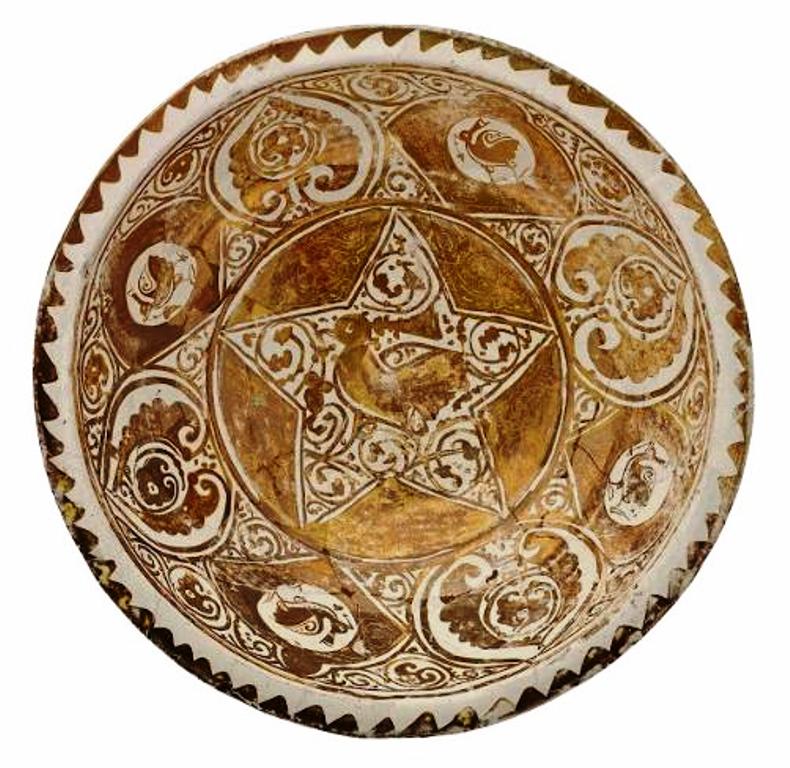
A large Fatimid ceramic bowl with birds and palmettes. Signed by the artist Muslim. From Egypt, 11th century. D. 37,5 cm. (ΓΕ_220).

diameter

37.5

Derechos de la imagen

Benaki Museum

Thursday, January 3, 2013

Lustre dish


Lustre dish

Lustre dish 
(1000 - 1099)

Unknown

Fragment of a large ceramic dish decorated in lustre colors. The main theme consists of two male figures on either side of a tree. A musician is playing a string instrument and a courtier is filling a glass from a flask. On the wide rim is a Kufic inscription expressing good wishes, from which only one part is preserved ('...perfect long life and blessings...perfect joy...') From Egypt, 11th century. D. 39,2 cm. (ΓΕ_11120).

diameter

39.2

Derechos de la imagen

Benaki Museum

Fragment of a shawl


Fragment of a shawl Fragment of a shawl 
(1100 - 1199)

Unknown

Fragment of an inscribed shawl attributed to the workshops of Fayyum. The inscription is benedictory ('…blessing and happiness and safety…'). Egypt, 9th-10th century. L. 74 cm., W. 91,5 cm. (ΓΕ_15608).

length

91.5

Derechos de la imagen

Benaki Museum

Marble fragment of a cenotaph


Marble fragment of a cenotaph

Marble fragment of a cenotaph 
(800 - 899)

Unknown

Marble fragment of a cenotaph inscribed in foliate Kufic: 'In the name of God the Merciful the Compassionate'. From Egypt, 9th century. H. 36 cm., W. 49 cm. (ΓΕ_10779).

Derechos de la imagen

Benaki Museum

Casket


Casket

Casket 
(1100 - 1200)

Unknown

Ivory casket with painted decoration. Italy, Sicily, 12th-13th century. H. 13,8 cm., D. 12 cm. (ΓΕ_10636).

diameter

12

Derechos de la imagen

Benaki Museum

Wednesday, January 2, 2013

Caftan


Caftan

Caftan
(1500 - 1599)

Unknown

The short-sleeved Ottoman robe, or caftan, is made of silk with gilt metal threads. The overall pattern is symmetrical on a red ground with undulating stems that carry multi-petalled flowers and larger circular motifs reminiscent of pomegranates filled with three small tulips and defined by a pearl border on blue. The yellow silk on the sleeves is a later repair. Turkey, 16th century. H. 134 cm., W. 126 cm. (ΓΕ_3900).

Derechos de la imagen

Benaki Museum

Part of a reception hall


Part of a reception hall

Part of a reception hall
(1600 - 1699)

Unknown

Part of a reception hall with a fountain in the centre of the inlaid marble floor, including a cascade with running water under the arch and two wall units. Though dating from the Ottoman period, the geometric pattern of the floor is based on mamluk prototypes. From Cairo. (ΓΕ_10836-ΓΕ_10840).

Derechos de la imagen

Benaki Museum

Amulet


Amulet
(1600 - 1799)

Unknown

Octagonal amulet decorated with inlaid gold and an inscription from the Qur’an (68: 51–52). Amulets of this sort were worn as armbands, and contained microscopic copies of the Koran. Possibly Deccan, 17th–18th century. H. 2 cm., D. 4 cm. (ΓΕ_13247).

diameter

4

Derechos de la imagen

Benaki Museum

Gold seal of the British colonel D’Arcy Todd


Gold seal of the British colonel D’Arcy Todd

Gold seal of the British colonel D’Arcy Todd
(1840 - 1841)

Unknown

The seal has a border carved with Persian verses and a central part inscribed with the name of D’Arcy Todd referring to him as the envoy of the mighty government of England to the Indies. The handle of the seal is decorated with enamelled floral motifs typical of the Qajar period and with a portrait of a European nobleman, perhaps the seal’s owner. Iran, AH 1256 (1840/1). H. 2,8 cm. (ΓΕ_21772).

length

3.6

Derechos de la imagen

Benaki Museum

Textile fragment


Textile fragment
(1100 - 1199)

Unknown

The main decorative feature on this narrow linen and silk textile is the portrayal of a male figure under an arch with distinctive, slender columns and a hanging lamp in the center. The figure is shown in the orans position with the hands raised in prayer. The arch appears to be inscribed in Arabic but the script is illegible. It may include the standard basmala, 'In the name of God'. The arch is flanked by rows of stylized floral motifs and below them are decorative bands, two of which feature stylized birds and fish. From Egypt, 12th century. H. 24,8 cm., W. 15,7 cm. (ΓΕ_15040).

Derechos de la imagen

Benaki Museum

Section of a panel of six tiles


Section of a panel of six tiles Section of a panel of six tiles
(1570 - 1590)

Iznik workshop

Section of wall tiles with a composition that constitutes a basic decorative unit which, when repeated, may cover any wall surface. A similar wall composition can be found in the Mausoleum of the Martyr Eyyub in Istanbul. Turkey, Iznik, circa 1580. H. 72,8 cm. Gift of Emmanuel Benakis (ΓΕ_68, ΓΕ_72, ΓΕ_109).

Spouted jug


Spouted jug
(1200 - 1230)

Unknown

Spouted jug The jug is covered with a transparent turquoise glaze and has two feline-shaped handles and two bullhead-shaped spouts. The designs are vertical compositions of leaf motives intercepted by curving peacock feathers. Two bands of inscriptions, en reserve on a black background read a Persian poem in the form of a ruba’i (quatrain) that was a popular type of verse established by the end of the 10th century. The interior is decorated with a group of fish. From Iran early 13th century, 15,5 cm Gift of Marina Lappa-Diomidous (ΓΕ 1401)

diameter

19.8

Derechos de la imagen

Benaki Museum

Bowl with the tuğra of Bayezid II


Bowl with the tuğra of Bayezid II
(1481 - 1512)

Unknown

      Detalles      Map      Bowl with the tuğra of Bayezid II Hemispherical silver bowl with a facetted honeycomb cavetto and a rivet in the centre showing where a disc was once attached. The underside is engraved with elongated split leaves found on late 15th century illuminations and Iznik ware. One of the cells is stamped with the tuğra of Bayezid II, the earliest known monogram of a sultan which serves as a control stamp guaranteeing the purity of the silver. From the Balkans, late 15th-early 16th c. D 12.5 cm. (ΕΑ_909)

diameter

12.5

Derechos de la imagen

Benaki Museum

Belt elements


Belt elements
(900 - 999)

Unknown

Belt elements Composed of a central rosette, eight bars and two finials, these belt elements are decorated with domes and granulation designs. Several features compare with Iranian pieces including the box construction and the minute granulation covering completely most of the domes. An early date is supported by the conspicuous absence of openwork filigree used in Fatimid jewellery. Similar belt elements were found in the Bekaa valley in Lebanon, in a hoard of Mamluk and other later jewellery. Said to come from Samarra, 10th c. L 27 cm (ΓΕ 1856)

length

27

Derechos de la imagen

Benaki Museum

Spherical component of a mosque lamp


Spherical component of a mosque lamp
(1530 - 1550)

Iznik workshop

Spherical component of a mosque lamp A ceramic spherical component of a mosque lamp decorated with rosettes, cloud scrolls and arabesques. Stylistically, it is related to an inscribed mosque lamp, in the British Museum, that bears the signature of the artist Musli al-Din and the date 1549. It is quite possible that both items are works of the same artist, created on the occasion of the restoration of the Dome of the Rock at Jerusalem by Süleyman the Magnificent. From Turkey, mid 16th c. H 23 cm (ΓΕ_9)

diameter

27

Derechos de la imagen

Benaki Museum

Tuesday, January 1, 2013

Pair of wooden doors


Pair of wooden doors 
(740 - 799)

Unknown

The pair of doors was found dismantled as parts of a sarcophagus in Iraq. The main decorative theme is a tree motif combined with geometrical and architectural motifs surrounded by vine scrolls and foliage. The collection of these elements and the rich carved ornamentation is traceable in the architectural decoration of late Umayyad art as presented in the desert palaces of Mshatta and Qasr Tuba. From Iraq, mid 8th century. H 255 cm W 123 cm. (ΓΕ 9121)

Derechos de la imagen

Benaki Museum